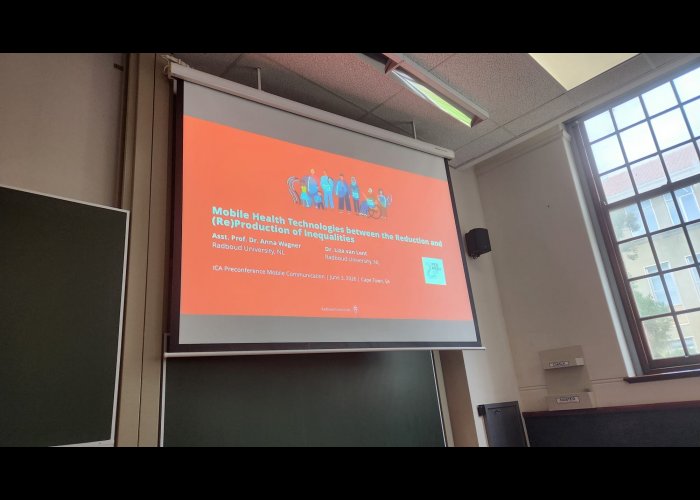
Prev-CID Research Presented at ICA 2026 in Cape Town
How can digital health technologies help reduce health inequalities, and where might they risk reinforcing them? These questions were at the centre of discussions at the International Communication Association (ICA) Conference, one of the leading international conferences in the field of communication research, held from 4–8 June in Cape Town, South Africa. As part of the pre-conference Mobile Communication & Inequalities in Context, Anna Wagner from Radboud University presented joint work with Liza van Lent based on research conducted within the PerPrev-CID project. Their presentation, Mobile Health Technologies between the Reduction and (Re)production of Inequalities, examined how AI-based prediction tools and mobile health technologies may help reduce health and social inequalities while also carrying the risk of reinforcing existing disparities among patient groups.
Drawing on interviews with 24 people living with rheumatoid arthritis (RA) and inflammatory bowel disease (IBD), the research explored these questions from the patient perspective. In particular, it examined where digital health tools may help reduce inequalities in care, as well as which differences between patients need to be considered when implementing such technologies in practice. The presentation highlighted the importance of considering factors such as socioeconomic circumstances and health status when developing and implementing AI-based prediction tools. As digital health technologies become increasingly integrated into healthcare, understanding how different patient groups may experience and benefit from these tools remains a key consideration.
This patient-centred perspective lies at the heart of PerPrev-CID and continues to guide the development and testing of the project's digital tools. By working closely with people living with RA and IBD through IFCCA and EULAR, the project seeks to ensure that patient experiences and priorities are reflected throughout the research process.